Hotelling revisits the lab: equilibration in continuous and discrete time
Economics
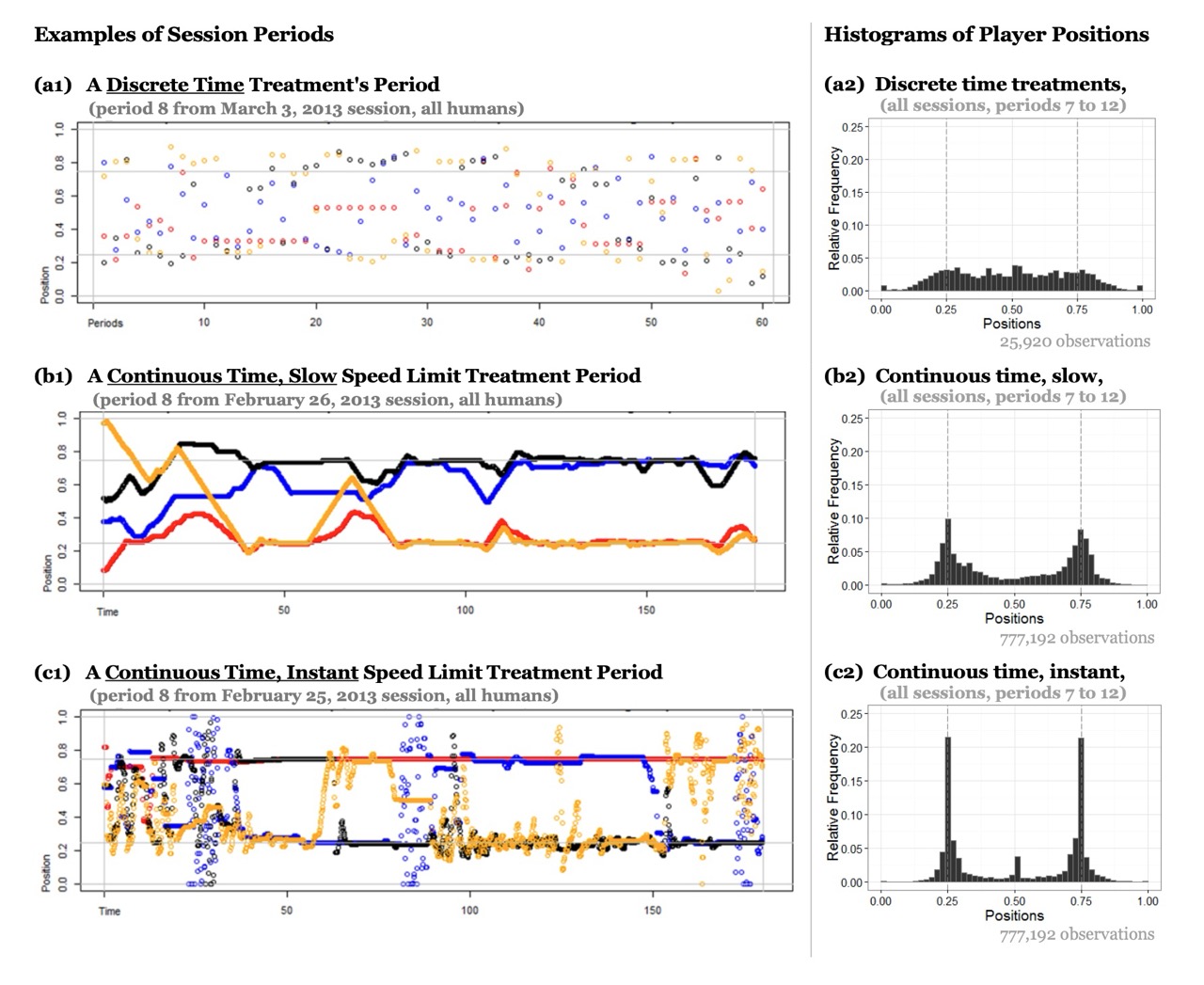
This paper asks a deceptively simple question: does the way competitors adjust their choices determine whether they reach the equilibrium economists predict? In the lab, firms repeatedly miss the mark when everyone moves at once, but allowing them to reposition continuously transforms a restless scramble into a remarkably orderly pattern.
Written with Daniel Friedman.
Abstract: We investigate experimentally the impact of continuous time on a four-player Hotelling location game. The static pure strategy Nash equilibrium (NE) consists of firms paired-up at the first and third quartiles of the linear city. In a repeated simultaneous move (discrete time) treatment, we largely replicate previous findings in which subjects fail to converge to the NE. However, in asynchronous move (continuous time) treatments we see clear convergence towards the NE.
View the article at the Journal of the Economic Science Association