Solow Growth Model - Videos
A video tutorial and walk-through of the Solow growth model, beginning with the basic setup and assumptions, the capital accumulation equation, the steady state, the Solow diagram, transition dynamics, and convergence. The model is then extended to incorporate population growth and labor-augmenting technological progress.
The following videos are designed as a teaching aid for my intermediate level macroeconomics discussion tutorial. All errors are my own.
Solow Growth Model - Video Tutorial
The Solow Growth Model (aka the Solow-Swan model, the exogenous growth model, or the neoclassical growth model) is a model of long-run economic growth. It relates growth in a model economy to productivity (via a production function & a process for technology growth), capital accumulation (via a law of motion of capital, with investment defined by an exogenous savings rate, and exogenously defined depreciation), population growth, and a process for technology to accumulate.
At its simplest, the model demonstrates how these features can combine into a neoclassical framework (i.e. the set of model features we usually start off the course with: production function, rational economic agents, markets in equilibrium, etc.) and result in steady state level of capital (or steady state per-effective worker level with labor-augmented technology growth), which results in balanced growth of output-per-person. Usefully, the model can also show how various shocks and policy tweaks may result in different economic outcomes.
However, the Solow model is only part, and just the start of the story explaining economic growth.
Outline of Solow Model Series:
- Introduce simple solow model.
- Model’s set-up and assumptions.
- Capital accumulation equation
- Steady state
- Solow diagram
- Transition dynamics and convergence
- Time Series chart of solow model
- Applications of the simple version of the model.
- Extend model to include population growth.
- Extend model to include technology growth (exogenous and constant labor augmented technology).
- Growth Rates of key variables - level effects vs. growth rates.
- Empiricals: How well does the solow model fit the data? How well does the model explain economic growth?
- Applications & examples of “full” solow-swan model.
- Odds and ends.
- Golden rule level of capital (and savings rate)
- Solow residual
Key Concepts
- Solow growth model
- Savings Rate
- Depreciation
- Stock vs flow
- The capital accumulation equation (the law of motion of capital)
- Diminishing returns
- Net investment
- Steady state
- Solow Diagram
- Absolute vs. conditional convergence
- Golden rule level of capital
- Effective labor
- Efficiency of labor
- Human capital
- Labor-augmenting technology
- Models of exogenous growth
- Balanced growth path
- Transition dynamics
- Level effect
- Growth effect
- Convergence
Simple Solow Model
We walk through the simple Solow model (no population growth, no technology growth, not too much too complicate the model yet)
View Video Playlist (9 vids 1:55:00)
- Introduction and Motivation for the Model
- Solow Model Set-up & Assumptions
Set-up model, discuss assumptions, notation and key variables & parameters. We also start working toward the steady state level of capital. - Solow Diagram
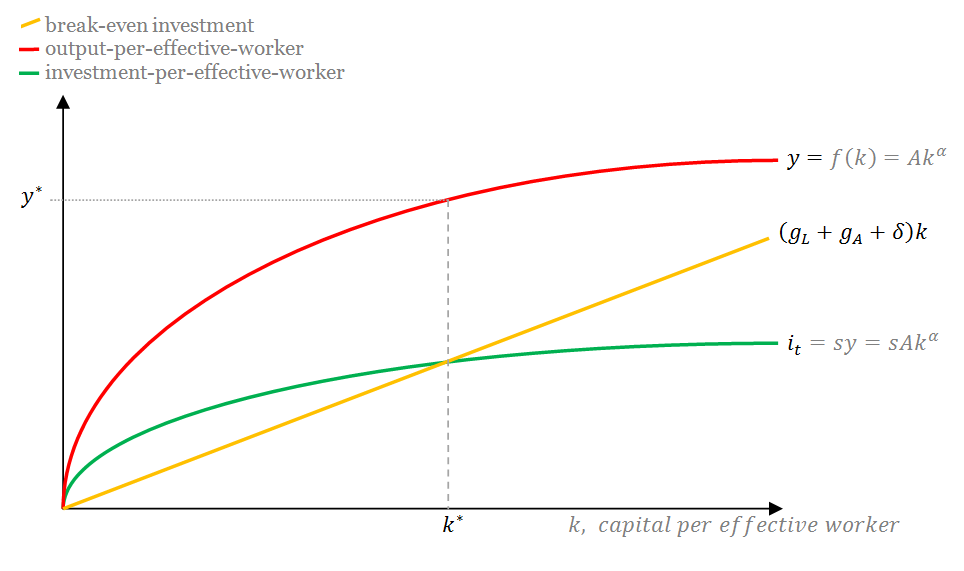
It’s useful to convert the solow model’s equations into a diagram. For many, the model’s insights become much more apparent. - Solow Model Transition Dynamics
The Solow model is a dynamic model, meaning we can plot how our variables of interest evolve through time. This helps us better understand convergence to the steady state and the effect of shocks to the model economy.
Applications and Example Problems of Simple Solow Model
Working with the very simple model: Shocks to the solow model plus their effect via solow diagram and time-series. Some intuition.
- Numerical Example - Calculate the Solow Model’s Steady State, and Compare Economies with Different Savings Rates
We work through a rather simple version of the Solow model. We’ll then find the steady values of per-worker capital, investment, consumption and production. Then, we’ll compare two economies - one with a relatively high savings rate and one with a relatively low savings rate - and we’ll see how the dynamics of these two countries differ. - How does destruction of capital affect the Solow Model?
The effect of an instant reduction of the capital stock (e.g. war!). Application of solow model, diagram and time series. Discussion of convergence to steady state. - Change in the savings rate in the Solow Model
What happens when the savings rate changes? Does capital & output per-worker increase or decrease in a consistent way? We’ll find the answer depends. - Change in the depreciation rate in the Solow Model
The effect of an increase in the rate of depreciation (the rate at which capital loses productive value from one period to the next. - Change in total factor productivity (technology)
The effect of an increase in TFP in the simple solow model.
Solow Model with Population Growth
Adding in exogenous population growth doesn’t change the model much, but some steady states become balanced growth paths. I walk through the extended model below.
View Video Playlist (2 vids 36:55)
- Set-up of Model with Labor Growth Added
A quick review of the solow model, and how population growth fits into the existing framework. - Solve for New Law of Motion of Capital-per-Worker
How to calculate the new per-capita capital accumulation equation with the addition of exogenous population growth. - Show Growth Rate of \(k^{*}\), \(y^{*}\), Y, I, K and C
As we calculate the new steady state values with population growth, we discover that the aggregate variables (Y, K, I, & C) are no longer steady states, and instead grow at the rate of population growth. We find the steady state level of capital-per-worker and output-per-worker. - Solow Diagram with Population Growth
The solow diagram changes slightly with the addition of population growth. - Transition Dynamics, “Level Effects” and Growth Rate Changes
Review of what shocks to exogenous variables (the parameters for savings, depreciation, technology, population growth rate, etc.) effect our dynamic variables. We find that some shocks have level effects and others have growth effects.
Solow Model with Technology Growth and Population Growth
- Adding in Technology to Solow Model
We discuss neutral, capital augmenting and labor augmented technology. (The model we’ll be working with incorporates labor augmented technology). - New Model Set-up, Notation and Assumptions
- A Focus on the “Effective Worker”
We discuss why this model (with technology growth) focuses on the ‘per effective worker’ instead of ‘per-capital’ level. It turns out the steady state is only in per-effective-worker level of capital and output. - New Law of Motion of Capital-per-Effective-Worker
We derive the capital accumulation equation with technology growth. - Show Growth Rate of \(\hat{k}^{*}\), \(\hat{y}^{*}\), \(k^{*}\), \(y^{*}\), Y, I, K and C
We calculate the ‘steady state’ values with labor augmenting technology growth and discover that the aggregate values (Y, K, I & C) and per-capita levels (y, k, i & c) are not steady states. They instead go at a rate related to the growth rate of technology and population growth. - Solow Diagram with Technology and Population Growth
- Calculating Growth Rates of Key Variables
We derive the growth rates of the major model variables: Y, K, I, C, y, k, i, c, \(\hat{k}\) and \(\hat{y}\). Nice little summary table there too. - Transition Dynamics, Level Effects and Growth Rate Changes
- Summary of Solow Model - what does the model tell us about economics growth? How well does the model hold up to observable facts?
Applications of extended solow model
Working with the solow-swan model with technology growth and population growth. Given the following shocks, we look at the effect on the solow diagram, and show time series analysis on the major economic variables.
- Destruction of Capital (K vanishes, war!)
What is the effect on the Solow model (with technology and population growth) of a sudden decrease in the capital stock? - Varying the Savings Rate (s↑ or s↓)
What is the effect on the Solow model if a sudden decrease in the savings rate (also discussed, a sudden increase in savings). - Changes in the Depreciation Rate (δ↑)
What is the impact on the Solow model of an instant change in the depreciation rate (either increase or decrease)? - Changes in Population Growth Rate (n↓ or n↑)
How does a change in the population growth rate effect the Solow model (with technological change)? - Changes in Technology Growth Rate (g↑ or g↓)
What is the effect on the Solow growth model of a sudden change in the technological growth rate? (both an increase and a decrease in technology growth)?
Additional Content
- Numerical Example of Solow Model
Given a parameterized model, find the steady state. - Golden Rule Level of capital
We discuss consumption as the best proxy in the model for welfare and how there is a level of per-worker capital that maximizes consumption. We then find the golden rule level of per-worker capital, and calculate the savings rate the leads to the golden rule level of capital. - Solow Residual — an estimate of Total Factor Productivity
* Migrated from my old google-sites & cazaar.com personal website in 2026.